
Research Highlights

-
Structure–Property Relationships of Near-Infrared Cyanine Dyes: Chalcogen-Driven Singlet Oxygen Generation with High Fluorescence Efficiency
-
Transiently delocalised hybrid quantum states are gateways for efficient exciton dissociation at organic donor-acceptor interfaces
-
Electrically Tunable Friction through Surface Adsorption Layer Restructuring
-
Atomate2: modular workflows for materials science
-
Orbital Magnetic Field Driven Metal-Insulator Transition in Strongly Correlated Electron Systems
-
On the reproducibility of free energy surfaces in machine-learned collective variable spaces
-
Recrystallization Mechanisms of Aluminum and Aluminum Oxide Interfaces through Reactive Simulations
-
Surface-Driven Electron Localization and Defect Heterogeneity in Ceria
-
Modelling Silica using MACE-MP Machine Learnt Interatomic Potentials
-
Low-density amorphous ice contains crystalline ice grains
- Structure–Property Relationships of Near-Infrared Cyanine Dyes: Chalcogen-Driven Singlet Oxygen Generation with High Fluorescence Efficiency
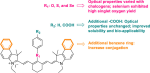 We developed and studied eight new dyes that absorb and emit light in the near-infrared region, which is invisible to the human eye but very useful in medical and imaging applications. By changing one key atom in the dye structure – oxygen, sulphur, or selenium, we were able to fine-tune how the dyes behave. All of the dyes absorbed and emitted near-infrared light very strongly,… Read more: Structure–Property Relationships of Near-Infrared Cyanine Dyes: Chalcogen-Driven Singlet Oxygen Generation with High Fluorescence Efficiency
 - Transiently delocalised hybrid quantum states are gateways for efficient exciton dissociation at organic donor-acceptor interfaces
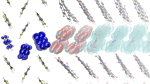 Organic solar cells have been at the centre of research attention in recent decades due to their ease of processing and dramatic rise in efficiency. However, the exact mechanism by which these devices absorb sunlight and convert this energy into a current remains without scientific consensus. Here, we report the development and application of X-SH, a quantum dynamics program that is able to simulate the… Read more: Transiently delocalised hybrid quantum states are gateways for efficient exciton dissociation at organic donor-acceptor interfaces
 - Electrically Tunable Friction through Surface Adsorption Layer Restructuring
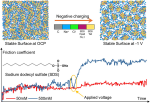 Recreating issue where any amendments published result in the opening of a new tab which did not happen before This research reveals that ‘tuning’ friction of surfactant-containing solutions with electricity depends less on the lubricant’s soap-like molecules and more on the sodium ions surrounding them. In a steel-on-steel system, the lubricant molecules naturally form protective, log-shaped ‘rollers’ that keep friction low; however, applying a negative… Read more: Electrically Tunable Friction through Surface Adsorption Layer Restructuring
 - Atomate2: modular workflows for materials science
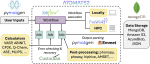 Automated ab initio calculations have emerged as a powerful tool for computational materials science. Automated workflows offer many benefits over traditional manual approaches, including reproducibility, scalability, and useability. This work presents atomate2, a library of over 100 computational materials science workflows. Atomate2 is now the software infrastructure that powers the Materials Project database. Key features include the support for multiple electronic structure packages and interoperability between them,… Read more: Atomate2: modular workflows for materials science
 - Orbital Magnetic Field Driven Metal-Insulator Transition in Strongly Correlated Electron Systems
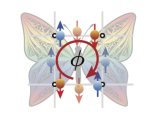 Magnetic fields drastically alter the electronic spectrum, producing a fractal structure known as the Hofstadter butterfly. Our paper demonstrates that this modification of the spectrum induces a phase transition from a Mott insulator to a metal. The image illustrates how the butterfly drives the motion of electrons, thereby transforming an insulator into a metal.
 - On the reproducibility of free energy surfaces in machine-learned collective variable spaces
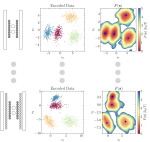 Many of nature’s most interesting physical, chemical, and biological processes exist on timescales beyond the reach of atomistic simulations. A common way for practitioners to still sample these processes in simulations is to identify a small set of coordinates that capture the relevant physics and describe the progress of the process of interest, so called Collective Variables (CVs). Simulations are then accelerated along these variables… Read more: On the reproducibility of free energy surfaces in machine-learned collective variable spaces
 - Recrystallization Mechanisms of Aluminum and Aluminum Oxide Interfaces through Reactive Simulations
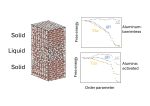 This study used reactive molecular dynamics (ReaxFF) and unsupervised clustering to analyse how aluminium and alumina crystallise from the melt. Aluminium atoms crystallise rapidly via a barrierless process, while alumina grows more slowly through a sequential mechanism: oxygen atoms incorporate first, facing significant free energy barriers, followed by aluminium atoms. Per-atom Gibbs free energies and bond-orientational order parameters revealed that atomic charge, especially for oxygen,… Read more: Recrystallization Mechanisms of Aluminum and Aluminum Oxide Interfaces through Reactive Simulations
 - Surface-Driven Electron Localization and Defect Heterogeneity in Ceria
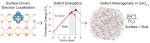 The exceptional performance of ceria (CeO2) in catalysis and energy conversion is fundamentally governed by the presence of defects in the material, particularly oxygen vacancies. The formation of each oxygen vacancy (VO), which carries an effective +2 charge, is assumed to be compensated by two localised electrons on cations (Ce3+) close to the VO. We show that, while this 1VO : 2Ce3+ ratio accounts for the global charge compensation,… Read more: Surface-Driven Electron Localization and Defect Heterogeneity in Ceria
 - Modelling Silica using MACE-MP Machine Learnt Interatomic Potentials
 Zeolites and silica polymorphs are central to numerous industrial and environmental applications, including catalysis, gas separation, and CO₂ capture. As such, accurate and efficient modelling tools are crucial for advancing the rational design and understanding of these materials. The MACE-MP framework offers a unified solution capable of handling both dense and microporous silica structures with varying coordination environments, materials of high importance from earth sciences… Read more: Modelling Silica using MACE-MP Machine Learnt Interatomic Potentials
 - Low-density amorphous ice contains crystalline ice grains
 Ice on Earth typically adopts a neatly arranged hexagonal crystalline structure. A range of amorphous ices—solids without long-range order—also exist. The oldest known form is called low-density amorphous (LDA) ice. LDA has traditionally been viewed as a “snapshot of liquid water”. Now, scientists have discovered tiny crystallites embedded within this amorphous material. They used two computer models to determine the structure of LDA: One model… Read more: Low-density amorphous ice contains crystalline ice grains